Amazon's Cancel Trap #10
What can a $2.5B settlement, 35M frustrated customers, and a cancellation maze teach us about product design? Let’s unpack Amazon Prime’s infamous “Iliad Flow” and see what product teams can learn about building (and breaking) user trust.


From “Cancel Anytime” to the "Iliad Flow"
Amazon built Prime into one of the most successful subscription programs in history.
Fast delivery, streaming, exclusive deals: a bundle that became almost essential.
By 2025, analysts estimated 197M subscribers and $44B in revenue from Prime alone❗
But behind the growth story, another story was cooking: cancellation flow.
Internally, Amazon employees nicknamed it the “Iliad Flow.”
Why? Like Homer’s epic (nearly 16,000 lines across 24 books, chronicling the long and brutal Trojan War), it was long, winding, and exhausting 😩.
Users faced ambiguous buttons like “Remind me later” or “Keep my benefits.”
The real “Cancel” option was buried. Many who tried to cancel found themselves looped back to the start.
The outcome?
- 35M people harmed by deceptive flows (almost the population of Canada!).
- A $2.5B settlement with the FTC - the largest of its kind.
- $1.5B refunded directly to users (up to $51 each), plus a $1B civil penalty.
The FTC Chair even celebrated ending these “deceptive subscriptions that feel impossible to cancel.”
The insight?
Trapping users may reduce churn on paper, but it destroys trust.
Why Easy Cancellation Matters
For subscription businesses, ease of cancellation isn’t just nice-to-have. It’s fundamental to trust and long-term growth.
Companies that trap users into staying pay a steep price:
- Support overload.
Frustrated users flood support, raising costs and straining teams. - Reputation damage.
People share bad stories. Reviews tank. Acquisition costs rise. - Refunds & chargebacks.
Angry users dispute charges, putting you at risk with payment providers. - Lost loyalty.
A cancelled customer could have returned later, unless you burned the bridge.
In short: difficult cancellations lead to band-aid churn solutions
Easy exits create goodwill, reactivations, and referrals 💪.
The Psychology of Offboarding
Why does cancellation UX matter so much?
Psychology explains it.
1. The Peak-End Rule
Users judge experiences by two moments: the peak and the end.
Even if onboarding was smooth, a painful ending shapes their memory of the product. Amazon’s “Iliad Flow” ensured the last impression was frustration.
2. Jakob’s Law
Users expect consistency. If signup takes one click, they expect cancellation to be just as easy. Breaking that expectation feels like betrayal.
3. Confirmshaming Backfires
Buttons like “No, I don’t want free shipping” may feel clever, but they guilt-trip the user. Instead of saving churn, they create resentment.
Takeaway: the end of the journey is as important as the beginning.
Respectful offboarding isn’t just nice –> it’s strategic! 🎯
How to Design User-Friendly Cancellation
So what does “easy cancellation” look like in practice?
1. Make it discoverable
Put the Cancel Subscription option exactly where users expect it.
Account –> Subscription. Same across web and mobile. No treasure hunts.
2. Keep steps short
One or two confirmations at most. Use clear labels like "Cancel Membership" instead of vague or softened language.
3. Respectful retention, not manipulation
It’s fine to ask why they’re leaving or offer a pause/downgrade. But never bury the exit or guilt-trip the user. Retention tactics should be friendly, not traps.
4. Clarify data handling
Tell users what happens to their data:
- Retained temporarily for reactivation?
- Permanently deleted after X days?
- Accessible for download/export?
Transparency here builds trust and avoids “what happens to my data?” anxiety.
5. Set billing expectations
Spell out exactly what cancellation means:
- Does service end now or at the end of the billing period?
- Will they receive a refund, prorated or not?
- Will they ever be charged again?
Follow with an email confirmation. A clear paper trail builds confidence.
What Good Looks Like
Not every subscription flow is a trap. Some companies get it right.
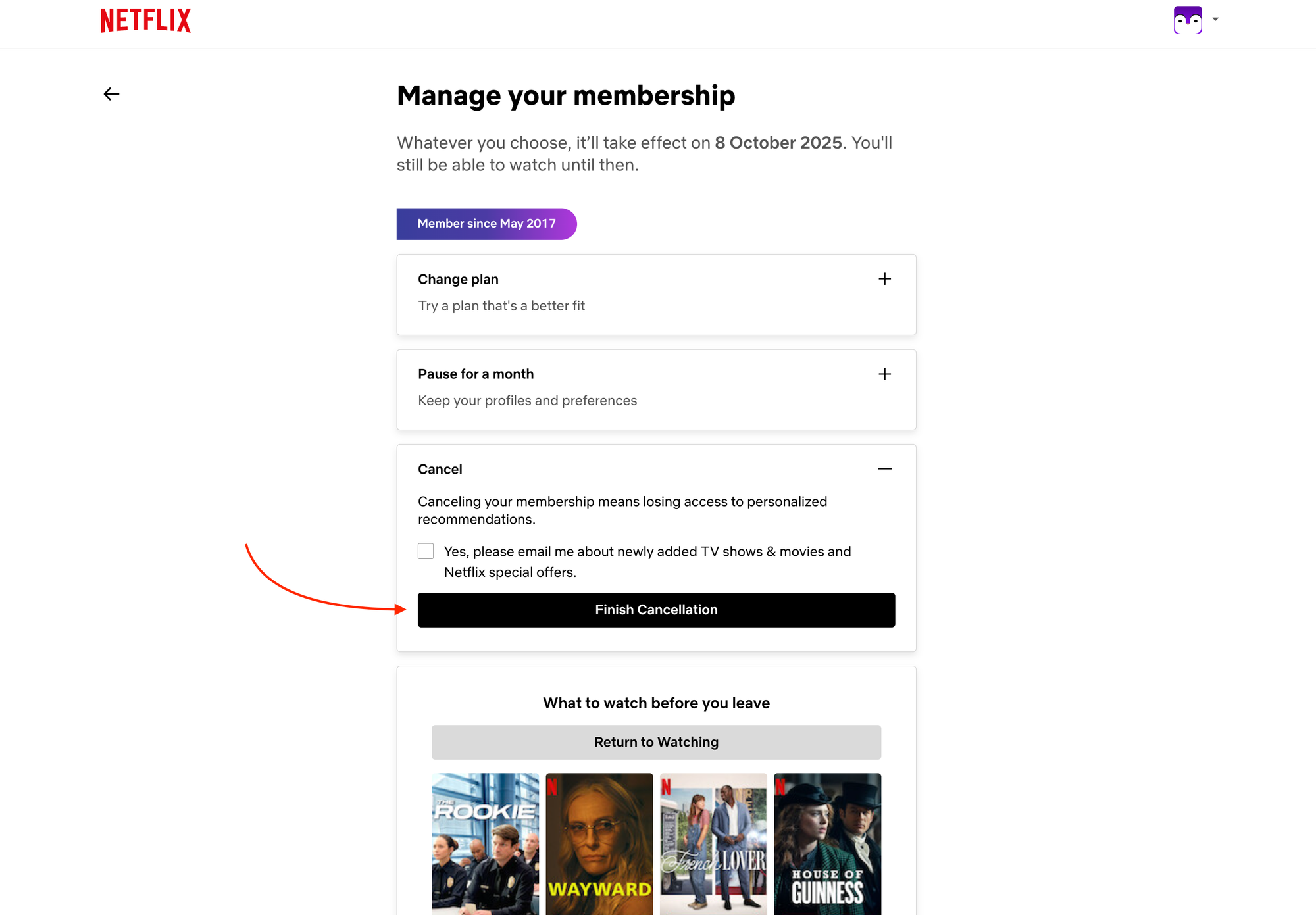
- Netflix –> Cancellation is one click, no guilt trips. They focus on value during active use, not lock-in at exit.
- Headspace –> Lets users pause or downgrade with friendly, non-manipulative language.
- Spotify –> Allows quick cancellation, then reminds users of playlists waiting if they come back.
All three understand the same principle: retention comes from value, not barriers.
A Playbook for PMs: Fixing Cancellation in 14 Days
If you’re leading a SaaS product, here’s how to turn insights into action fast:
Day 1-3: Audit your current flow.
- How many steps does cancellation take?
- Where do users drop off? Check the analytics as well...📊
- How many support tickets mention cancellation?
Day 4-7: Redesign.
- Single location.
- 1-2 steps.
- Clear copy.
- Data + billing explained.
- Optional pause/downgrade.
Day 8-10: Legal + CX review.
- Ensure compliance with FTC-style “Click-to-Cancel.”
- Localize for all supported markets.
Day 11-12: Roll out to 10-20%.
- Track completion time, support load, NPS at cancel, reactivation rate.
- Check drop-offs.
Day 13-14: Ship to 100%.
- Monitor anomalies.
- Share results with the org - churn you lose today may come back as reactivations tomorrow.
Trust as a Retention Strategy
The irony of Amazon’s saga: the company designed friction to keep users, and ended up paying billions, plus losing trust.
For SaaS and subscription products, the lesson is simple:
If your business relies on users failing to cancel, you don’t have retention. You have a trust problem.
Trust, not tricks, is the real retention engine 🚂.
- Users are more likely to sign up if they know they can leave easily.
- They’re more likely to return if offboarding was smooth.
- They’re more likely to recommend you if they feel respected, even at cancellation.
The Bottom Line
Amazon’s “Iliad Flow” is now a cautionary tale in product design.
Treat offboarding with the same care as onboarding.
Design flows that are:
- Discoverable (easy to find)
- Short (one to two steps)
- Transparent (data, billing, refunds)
- Respectful (alternatives, not traps)
When you empower users to leave on their own terms, you don’t lose them. You earn their trust.
And in the subscription economy, trust is the most powerful growth loop you can build.
🚀 Empower your users. They’ll reward you in the long run.
Let’s Connect
If this topic resonates and you’ve made it here, let’s connect and explore how these lessons can translate into growth for your product and team, and how I can support your organization’s product and UX journey.
I work with organizations to shape user experiences, dive into product psychology, and turn insights into strategy - whether you need hands-on product leadership, clear UX thinking, or even freelance support with product and marketing writing.
I bring my expertise into whatever form of help your team needs - from strategy workshops to words that tell your product’s story.
Want to chat?
→ Book a call
→ Connect on LinkedIn
New here? Welcome! Subscribe for more insights on product, design, and the sparks behind great software.